NASA Two Moons Earth – Understanding the Mystery of Earth’s Second Moon
Look up at the night sky and you’ll see one familiar companion shining above us: the Moon. For thousands of years, humanity believed Earth had exactly one natural satellite—and that seemed perfectly obvious. Yet in recent years, headlines across the internet have sparked curiosity and confusion with claims like “NASA confirms Earth has two moons.” It sounds like something straight out of science fiction. Two glowing lunar bodies rising over the horizon? Double the tides? Double the moonlight? The reality, however, is both more complex and more fascinating.
The truth is that Earth technically does not have two true moons. Our planet still has just one permanent natural satellite. However, astronomers have discovered objects that behave in ways that make them appear like temporary or companion moons. Some of these objects are called quasi-moons, while others are known as mini-moons—small asteroids that briefly get caught in Earth’s gravity before drifting away again.
One recent example fueling the debate is the asteroid 2025 PN7, which travels through space in a synchronized orbit with Earth around the Sun. Because of this unique motion, it sometimes appears to accompany our planet like a second moon, even though it’s actually orbiting the Sun rather than Earth itself.
Adding another twist, scientists have proposed that billions of years ago, Earth may actually have had two real moons that eventually merged into the single Moon we see today. If that hypothesis is correct, our sky once looked dramatically different from what we experience today.
Understanding the “NASA two moons Earth” topic requires exploring astronomy, orbital mechanics, and the dynamic nature of our cosmic neighborhood. When you start unpacking the science behind it, the story becomes even more interesting than the viral headlines.
Why the Idea of Two Moons Fascinates People
Ancient Myths and Modern Space Curiosity
Human beings have always been captivated by the Moon. Long before telescopes existed, ancient civilizations built myths and calendars around its cycles. The Moon influenced agriculture, navigation, and storytelling. When something becomes that deeply embedded in culture, even the smallest change to it sparks massive curiosity. So when headlines hint that Earth might have two moons, it naturally captures global attention.
The idea also taps into our imagination. Science fiction has long portrayed planets with multiple moons—think of the twin moons of Tatooine in Star Wars. When people hear that Earth might have a second moon, it blurs the line between fantasy and real science. Suddenly, the sky feels less predictable and more mysterious. That emotional reaction drives millions of searches online every time a new “second moon” story appears.
There’s another reason the concept resonates so strongly. Humans instinctively look for patterns and stability in nature. The Moon has been a constant presence throughout recorded history. Learning that our planet might occasionally gain temporary companions reminds us that the solar system is not static—it’s a constantly evolving gravitational dance.
In astronomy, discoveries often challenge our assumptions about how celestial systems behave. The realization that Earth can temporarily host small moons or share space with quasi-satellites expands our understanding of orbital dynamics. What once seemed impossible becomes scientifically plausible once you examine the physics behind it.
How Social Media Sparked the “Two Moons” Debate
The modern “two moons” debate didn’t start in an observatory—it exploded online. Viral headlines and dramatic social media posts frequently simplify complex astronomical discoveries. When researchers identify a new near-Earth asteroid moving in sync with our planet, it’s easy for news summaries to translate that into “Earth has a second moon.”
The problem is that astronomy terminology is precise, while social media language is often simplified. A quasi-moon is not the same thing as a true moon, but the difference can easily disappear in a click-driven headline. That’s exactly what happened when the asteroid 2025 PN7 was discovered and described as a “quasi-satellite” of Earth.
Once the story spreads online, speculation grows quickly. People begin imagining massive celestial bodies appearing in the sky overnight. In reality, these objects are usually tiny asteroids—sometimes only tens of meters wide—and often invisible to the naked eye. Despite their small size, their unusual orbital relationships with Earth make them extremely valuable for scientific study.
Ironically, the internet hype has a positive side effect. When millions of people search for answers about space phenomena, it encourages public interest in astronomy. Curiosity leads people to learn about orbital resonance, gravitational capture, and planetary formation. So even though the headlines can be misleading, the conversations they spark help more people engage with real science.
What NASA Actually Says About Earth Having Two Moons
The Discovery of Quasi-Moons
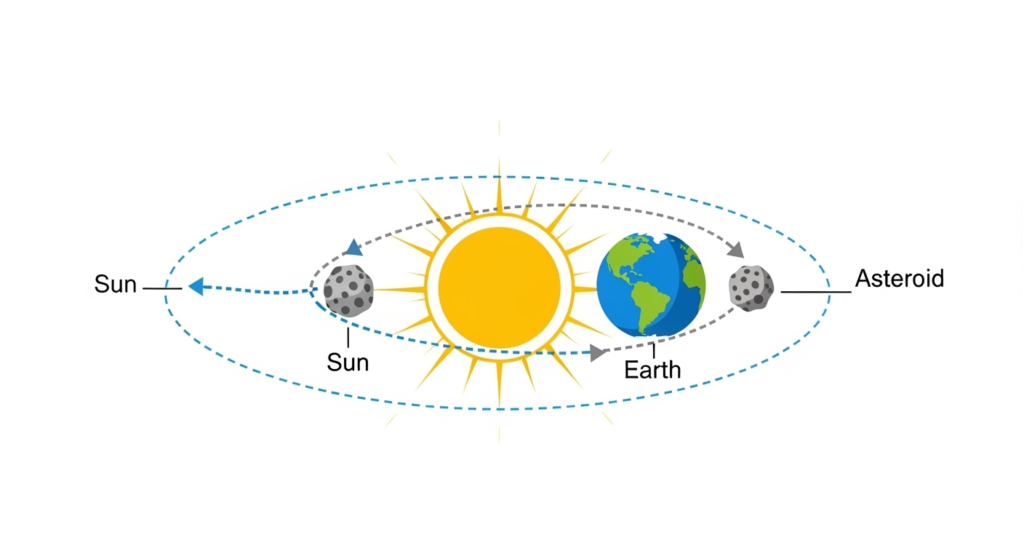
NASA and astronomers around the world closely monitor thousands of objects traveling near Earth’s orbit. Among these objects are a rare category known as quasi-satellites or quasi-moons. Unlike our real Moon, these bodies are not gravitationally bound to Earth. Instead, they orbit the Sun but stay in a synchronized pattern with Earth’s orbit.
Imagine two runners moving around a track at almost exactly the same speed. From one runner’s perspective, the other might appear to circle around them even though both are actually running around the stadium. That’s essentially how quasi-moons behave in space. Their orbit around the Sun keeps them close to Earth over long periods, creating the illusion that they are accompanying our planet.
Scientists study these objects because they provide valuable insights into the gravitational interactions within the solar system. They can reveal how asteroids migrate between planetary orbits and how Earth’s gravity influences nearby space rocks. In many cases, these objects come from the Arjuna asteroid group, a cluster of near-Earth asteroids with orbits very similar to Earth’s.
The discovery of quasi-moons shows that the region around Earth is far more dynamic than people once thought. Instead of being an empty void with just one satellite, our planet shares space with a constantly changing population of asteroids that occasionally behave like temporary companions.
Asteroid 2025 PN7 – Earth’s Recent Quasi-Satellite
One of the most talked-about discoveries in recent years is asteroid 2025 PN7. Astronomers found that this small asteroid moves around the Sun in a path nearly synchronized with Earth’s orbit. Because of this alignment, it appears to loop around our planet when viewed from certain perspectives.
Despite the dramatic headlines, PN7 is not a second Moon. The asteroid is only about 18 to 36 meters wide, making it tiny compared with our Moon’s 3,474-kilometer diameter. It also travels far from Earth—sometimes millions of kilometers away—meaning it has virtually no effect on tides, gravity, or Earth’s environment.
Researchers estimate that this asteroid has been traveling alongside Earth since the 1960s and may remain in this quasi-satellite configuration until around 2083, when gravitational interactions eventually shift its orbit away from our planet.
Even though it’s not a true moon, PN7 is scientifically important. Objects like this help astronomers refine models of orbital resonance and near-Earth object behavior. Studying them also improves planetary defense systems designed to track asteroids that might pose a potential impact risk in the future.
What Is a Quasi-Moon?
How Quasi-Moons Orbit the Sun
To understand quasi-moons, it helps to visualize the solar system as a massive gravitational choreography. Every planet, asteroid, and comet moves according to the gravitational pull of the Sun and other nearby bodies. A quasi-moon forms when an asteroid’s orbit becomes synchronized with a planet’s orbit around the Sun.
Instead of circling the planet directly, the asteroid travels around the Sun in roughly the same time it takes Earth to complete one orbit. Because their speeds match closely, the asteroid repeatedly approaches Earth from different angles during each orbital cycle. From our perspective, that motion creates looping paths that resemble an object orbiting Earth.
The key difference is that Earth’s gravity doesn’t fully capture the asteroid. The Sun remains the dominant gravitational force controlling its path. That distinction is why astronomers classify these objects as quasi-satellites rather than true moons.
This type of orbital relationship is surprisingly stable. Some quasi-moons can remain near Earth for decades or even centuries before gravitational interactions eventually alter their trajectory. During that time, they offer scientists unique opportunities to study asteroid composition and orbital mechanics without traveling far into deep space.
Why They Look Like Earth’s Companion
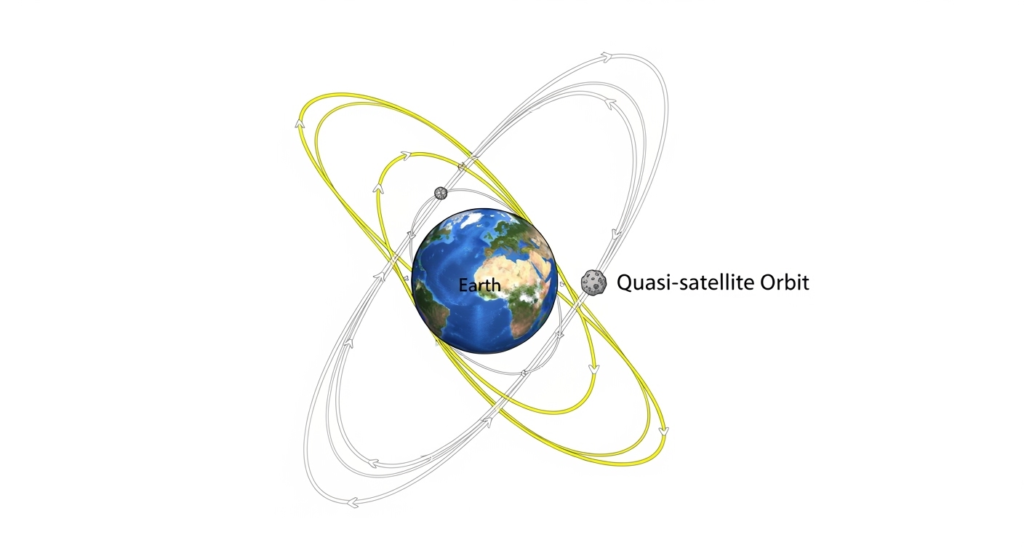
From Earth’s perspective, a quasi-moon’s motion can appear extremely unusual. Instead of moving steadily across the sky like distant asteroids, these objects seem to trace looping patterns relative to Earth. That illusion makes them look like they are orbiting our planet even though they’re actually orbiting the Sun.
This visual effect occurs because Earth and the asteroid are moving together through space. When their orbital speeds match closely, the relative motion between them becomes small. As a result, the asteroid appears to hover nearby while tracing complex paths.
Astronomers often describe these motions using rotating reference frames that follow Earth around the Sun. In these models, quasi-moons can appear to circle Earth in elongated loops. But when viewed from outside that reference frame, their true solar orbit becomes clear.
These fascinating orbital relationships highlight how gravitational physics can produce surprising cosmic behavior. Even small asteroids can create the illusion of a second moon simply by moving through space in just the right way.
The Theory That Earth Once Had Two Real Moons
The Giant Impact Theory
While quasi-moons explain modern headlines, there’s an even more dramatic scientific hypothesis: Earth may actually have had two real moons billions of years ago. This idea comes from simulations of the early solar system, a chaotic period when planets were still forming, and collisions between massive objects were common.
Most scientists believe our Moon formed after a Mars-sized body collided with the early Earth, ejecting huge amounts of debris into orbit. Over time, this debris merged to form the Moon we know today. This explanation is known as the Giant Impact Theory, and it remains the leading model for lunar formation.
Computer simulations of this event suggest that the debris disk around Earth could have produced multiple moonlets rather than a single large moon. In some scenarios, two sizable moons may have formed simultaneously and orbited Earth for millions of years.
The Collision That May Have Created One Moon
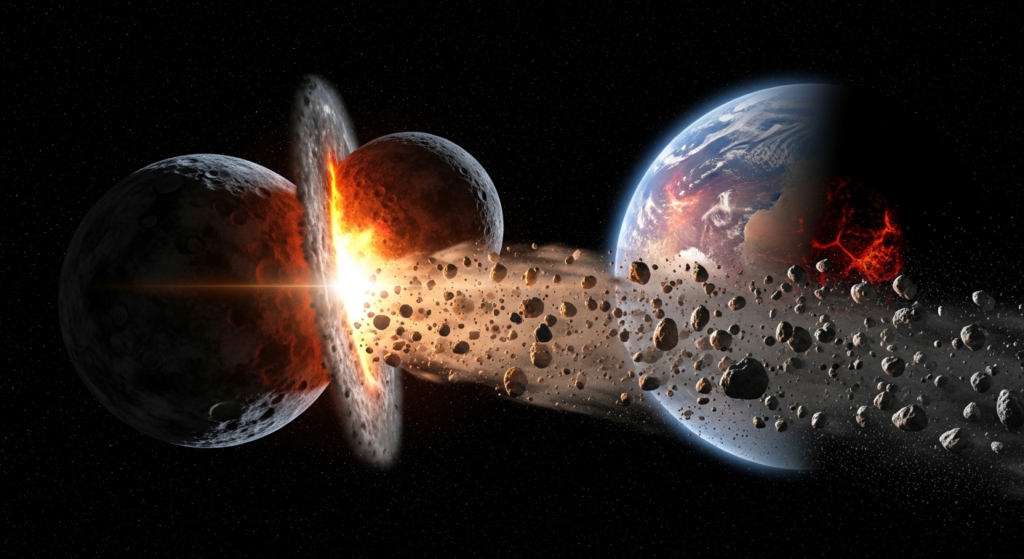
According to one model, these two moons eventually collided in a slow-motion impact. The smaller moon—estimated to be about 1,200 kilometers wide—may have crashed into the larger moon after gravitational interactions destabilized its orbit.
Instead of completely destroying both bodies, the collision likely merged them together. Scientists think this event could explain one of the Moon’s biggest mysteries: why the far side of the Moon has thicker crust and more mountainous terrain than the side facing Earth. The material from the smaller moon may have piled onto one hemisphere during the collision.
If this theory is correct, Earth’s night sky once featured two moons traveling together before eventually merging into the single lunar companion we see today. That dramatic cosmic event would have occurred billions of years ago—long before life existed on Earth.
What Would Happen If Earth Had Two Moons Today
Effects on Tides and Gravity
Imagining Earth with two moons isn’t just fun speculation—it’s also a fascinating physics exercise. Our current Moon already plays a major role in shaping Earth’s environment. Its gravity creates ocean tides, stabilizes Earth’s rotational axis, and influences the length of our days.
If a second moon of similar size existed today, tidal patterns would become far more complex. Instead of the predictable tidal cycles we experience now, coastal regions might see overlapping tidal forces from two different directions. In some cases, this could create stronger tides; in others, the forces might partially cancel each other out.
The gravitational interactions between the moons would also affect their orbits. Over time, their mutual pulls could alter their distances from Earth or even trigger orbital instability. Astronomers suspect that systems with two large moons often evolve toward a single-moon configuration due to these gravitational interactions.
Impact on Earth’s Climate and Nights
Two moons would dramatically change Earth’s night sky. Depending on their positions, nights might appear brighter than usual, especially during full moon phases. The presence of two luminous bodies could also create unique eclipse patterns where one moon occasionally blocks the other.
Climate stability might also change slightly. Our Moon helps stabilize Earth’s axial tilt, which contributes to relatively stable seasons. If a second moon altered that gravitational balance, Earth’s tilt might fluctuate more over long timescales.
Even so, the most noticeable difference for humans would likely be visual. Imagine stepping outside and seeing two glowing moons rising together above the horizon. It would completely transform the way we experience the night sky.
Why Scientists Study Near-Earth Objects
Planetary Defense and Asteroid Tracking
The discovery of quasi-moons and mini-moons is more than a curiosity—it plays an important role in planetary defense. NASA tracks thousands of near-Earth objects (NEOs) that pass relatively close to our planet. Studying their orbits helps scientists determine whether any pose a potential collision risk in the future.
Objects like quasi-moons are especially interesting because their orbits bring them repeatedly near Earth. By analyzing their trajectories, astronomers can improve models that predict how gravitational interactions influence asteroid paths.
Early detection systems rely on telescopes and automated surveys that continuously scan the sky. When scientists identify a new object, they calculate its orbit and monitor its future movement. This work helps ensure that humanity has advance warning if any potentially hazardous asteroid approaches Earth.
Opportunities for Future Space Missions
Quasi-moons may also become valuable targets for future space missions. Because their orbits stay relatively close to Earth, spacecraft could reach them using far less fuel than missions to distant asteroids. That makes them attractive destinations for scientific exploration or even resource utilization.
Studying these objects up close could reveal clues about the composition of early solar system material. Many asteroids contain primitive minerals and organic compounds that date back billions of years. By examining them directly, scientists can learn more about how planets formed and how water and organic molecules may have arrived on Earth.
In that sense, Earth’s temporary companions are not just scientific curiosities—they’re potential stepping stones for humanity’s expansion into deeper space.
The Future of Earth’s Quasi-Moons
How Long Earth’s Current Companion May Stay
Objects like asteroid 2025 PN7 demonstrate how dynamic our planetary neighborhood really is. Astronomers estimate that this asteroid could remain in its quasi-satellite relationship with Earth until around 2083 before gravitational interactions gradually pull it away.
Even after PN7 eventually leaves Earth’s orbital neighborhood, another asteroid may take its place. The solar system contains millions of small bodies, and many have orbits that occasionally intersect with Earth’s gravitational sphere of influence.
That means Earth could continue acquiring temporary companions for millions of years. Most of these objects will remain too small or too distant to see with the naked eye, but their presence reveals how active and interconnected our cosmic environment really is.
What Scientists Expect to Discover Next
Astronomers expect future telescopes to detect many more quasi-moons and mini-moons. Upcoming survey projects are designed to scan the sky with unprecedented sensitivity, allowing researchers to spot smaller and fainter objects than ever before.
As detection technology improves, scientists will likely uncover new types of orbital relationships between Earth and nearby asteroids. Some may remain near Earth for centuries, while others might only linger for a few months before drifting away.
Each discovery adds another piece to the puzzle of how planetary systems evolve. Instead of a simple system with one moon and empty space beyond it, Earth turns out to be part of a constantly shifting cosmic neighborhood filled with wandering companions.
Conclusion
The phrase “NASA two moons Earth” may sound sensational, but the real science behind it is even more fascinating. Earth still has only one true moon, yet our planet shares space with a variety of near-Earth objects that sometimes behave like temporary companions. Quasi-moons such as asteroid 2025 PN7 move around the Sun in synchronized orbits with Earth, creating the illusion that they are orbiting our planet.
Meanwhile, theories about the early solar system suggest that Earth might once have hosted two real moons that eventually merged after a slow cosmic collision.
Together, these discoveries reveal a deeper truth about space: the universe is far more dynamic than it appears from our vantage point on Earth. Planets, moons, and asteroids are constantly interacting, drifting, and reshaping their orbits over millions or billions of years.
So while you won’t see two bright moons rising over the horizon tonight, the story of Earth’s cosmic companions is still unfolding—and astronomers are just beginning to understand how complex our planetary neighborhood really is.
FAQs
1. Does Earth currently have two moons?
No. Earth has one true natural moon. Some asteroids, like 2025 PN7, are classified as quasi-moons because they move in synchronized orbits with Earth around the Sun, creating the illusion of a second moon.
2. What is asteroid 2025 PN7?
It is a small asteroid roughly 18–36 meters wide that travels in an orbit similar to Earth’s. Because of its orbital resonance, it appears to accompany Earth through space but does not orbit the planet directly.
3. What is a mini-moon?
A mini-moon is a small asteroid temporarily captured by Earth’s gravity. These objects may orbit Earth briefly before escaping back into solar orbit.
4. Did Earth ever have two real moons?
Some scientists believe that billions of years ago, Earth may have had two moons that eventually collided and merged, forming the Moon we see today.
5. Could Earth ever gain a second permanent moon?
It is extremely unlikely. Capturing a large object into a stable orbit requires very specific gravitational conditions that rarely occur in the solar system.