Understanding the Cygnus Constellation
What Exactly Is a Constellation?
If you’ve ever looked up at the night sky and noticed groups of stars forming patterns, you’ve already experienced the basic idea of a constellation. A constellation is simply a region of the sky where stars appear to form recognizable shapes or figures. These patterns helped ancient civilizations navigate, track seasons, and create stories that explained the cosmos long before telescopes existed.
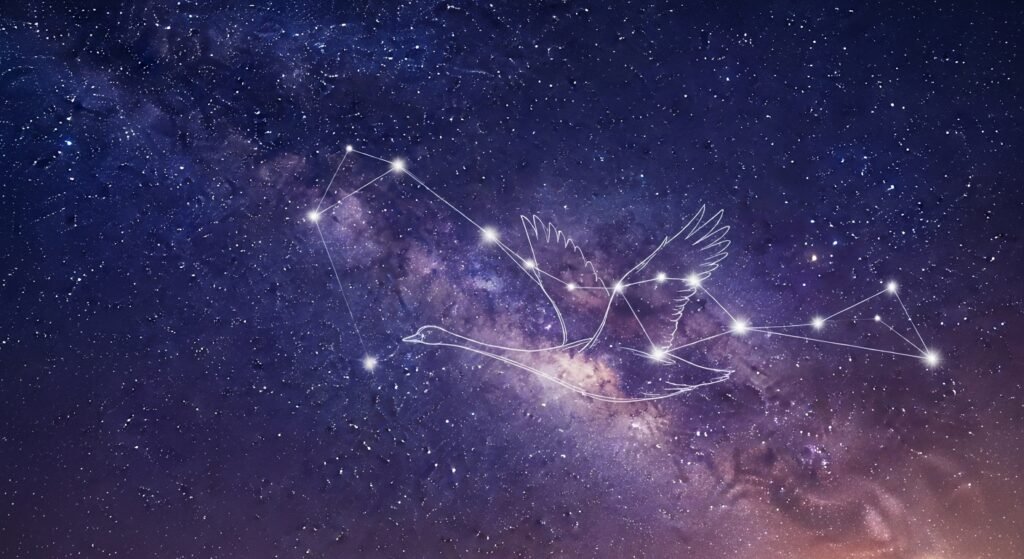
The Cygnus constellation is one of the most recognizable star patterns in the northern sky. Its name comes from the Latin word for “swan,” and the stars form a shape that resembles a swan flying through space. Astronomers classify Cygnus as one of the 88 modern constellations recognized today, and it was originally listed among the 48 constellations described by the ancient astronomer Claudius Ptolemy in the 2nd century.
Unlike random star groupings, constellations are officially defined areas of the sky used by astronomers to map and locate celestial objects. Think of them like countries on a world map—but instead of borders on Earth, they outline sections of the night sky. When astronomers say a nebula or star is “in Cygnus,” they mean it lies within this mapped region.
One of the reasons Cygnus stands out is its location along the Milky Way, the dense band of stars that stretches across the night sky. Because of this, Cygnus is packed with fascinating cosmic objects, including star clusters, nebulae, and even one of the first known black holes ever discovered.
In short, Cygnus isn’t just another star pattern. It’s a gateway into one of the richest and most exciting areas of the night sky for beginner astronomers.
Why Cygnus Is One of the Most Famous Constellations
Among all constellations visible in the northern hemisphere, Cygnus ranks as one of the most recognizable. In fact, it is the 16th largest constellation in the sky, covering an area of about 804 square degrees.
But its popularity isn’t just about size. Cygnus forms a striking shape known as the Northern Cross, which makes it incredibly easy to identify. Even someone with zero astronomy experience can often pick it out within minutes once they know what to look for.
Another reason Cygnus is so famous is because of its connection to the Summer Triangle, one of the most prominent star patterns visible during the warmer months. The Summer Triangle is formed by three bright stars: Deneb in Cygnus, Vega in the constellation Lyra, and Altair in Aquila.
Because Deneb is so bright, it acts like a cosmic signpost pointing directly to Cygnus. Once you locate Deneb, the rest of the constellation’s cross-shaped structure becomes much easier to trace.
Cygnus also attracts attention from professional astronomers. Within its boundaries lie extraordinary celestial phenomena, including:
- Massive star-forming regions
- Large glowing nebulae
- The famous Cygnus X-1, one of the first strong black hole candidates discovered
For amateur stargazers, Cygnus offers something equally special: an incredible number of visible stars even without a telescope. On a clear night away from city lights, the Milky Way appears to flow directly through the body of the swan, creating one of the most breathtaking views in the sky.
If the night sky were a theater, Cygnus would be one of the brightest stars on stage.
The Mythology Behind Cygnus
The Swan in Greek Mythology
Constellations often come with fascinating stories, and Cygnus is no exception. In Greek mythology, the constellation represents a swan associated with the god Zeus. According to one popular legend, Zeus transformed himself into a swan to approach either the Spartan queen Leda or the nymph Nemesis.
The image of a swan flying gracefully across the sky perfectly matches the shape of the constellation. The long line of stars represents the swan’s body and neck, while the horizontal line forms its wings. Ancient storytellers imagined the swan gliding along the river of the Milky Way, which runs straight through the constellation.
Greek myths weren’t just entertainment—they were early attempts to explain the universe. By connecting star patterns to legendary figures, people could remember the positions of stars and navigate at night.
Cygnus wasn’t just symbolic; it carried emotional meaning as well. Swans in mythology often represented transformation, beauty, and divine intervention. These themes appear repeatedly in stories associated with the constellation.
When you look up at Cygnus today, you’re seeing the same star pattern that ancient civilizations looked at thousands of years ago. The technology has changed dramatically, but the sense of wonder remains exactly the same.
How Ancient Civilizations Interpreted Cygnus
While the Greeks saw a swan in the stars, other cultures interpreted Cygnus differently. Ancient skywatchers often gave their own meanings to the same group of stars depending on their traditions and environment.
In many early cultures, Cygnus was associated with birds or flying creatures because of its elongated shape. Some ancient astronomers described it as a bird flying along the Milky Way, almost as if the galaxy itself were a celestial river.
This idea appears in multiple traditions because the Milky Way runs directly through the center of Cygnus. To the naked eye, this region looks like a glowing cloud of countless stars, making the swan appear as though it’s soaring through a luminous cosmic stream.
Over time, these interpretations merged into the constellation system used today. Modern astronomy no longer treats constellations as literal shapes or mythological beings. Instead, they serve as mapping tools for locating objects in space.
Even so, the mythology remains an important part of the night sky’s cultural history. When beginners learn about Cygnus, they’re not just studying stars—they’re connecting with centuries of human storytelling and curiosity about the universe.
Location of Cygnus in the Night Sky
Which Hemisphere Can See Cygnus
Cygnus is located in the northern celestial hemisphere, which means it’s easiest to see from locations north of the equator. However, it’s still visible from many parts of the southern hemisphere as well.
Observers at latitudes as far south as 40° south can see the constellation at certain times of the year.
That means people living in places like:
- Australia
- South Africa
- Chile
- Argentina
can still enjoy Cygnus during favorable seasons.
Because the constellation sits directly on the plane of the Milky Way, it appears in one of the most star-dense regions of the sky. This makes it particularly impressive when viewed from dark rural locations.
In urban areas with heavy light pollution, you might only see the brightest stars of Cygnus. But in darker skies, the constellation becomes dramatically richer, revealing countless faint stars scattered throughout the Milky Way.
The Best Time of Year to Observe Cygnus
Timing matters when it comes to stargazing. Fortunately, Cygnus appears during one of the most pleasant seasons for skywatching.
The constellation is most visible between July and November, with September often considered the best month for observation.
During these months, Cygnus climbs high into the evening sky and becomes easy to spot. In early autumn evenings, it often appears almost directly overhead.
When the sky grows dark, the cross-shaped pattern emerges clearly among the stars. The bright star Deneb marks the tail of the swan, while other stars trace its wings and neck.
The higher a constellation appears above the horizon, the easier it is to observe. That’s why Cygnus becomes particularly impressive during late summer and early autumn nights.
For beginners just starting to explore the night sky, this timing makes Cygnus a perfect first constellation to learn.
The Northern Cross Asterism
Why Cygnus Looks Like a Cross
One of the reasons Cygnus is so easy to recognize is its distinctive cross-like shape. Astronomers refer to this pattern as the Northern Cross.
An asterism is a recognizable star pattern that may form part of a constellation. In the case of Cygnus, the Northern Cross is the most noticeable feature.
The cross is formed by several bright stars:
- Deneb (tail)
- Sadr (center)
- Albireo (head)
- Two stars form the wings.
Together, they create a long vertical line intersected by a horizontal one. To many observers, it resembles a cross standing upright in the sky.
But if you rotate the shape slightly in your imagination, it transforms into the outline of a swan flying along the Milky Way.
This dual identity is one of the reasons Cygnus fascinates beginner stargazers. Depending on how you view it, the constellation can appear either as a cross or a graceful bird in flight.
The Relationship Between Cygnus and the Summer Triangle
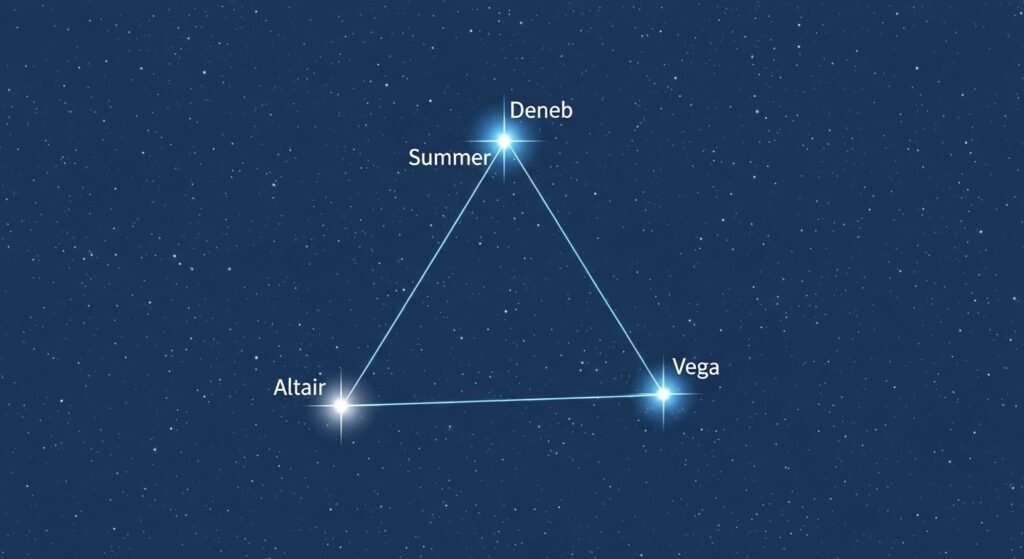
Cygnus also plays an important role in one of the sky’s most famous star patterns—the Summer Triangle.
The triangle consists of three bright stars:
| Deneb | Cygnus | Northern sky |
| Vega | Lyra | Very bright |
| Altair | Aquila | Summer evenings |
Deneb forms one corner of this massive triangle. Once you find Vega and Altair, tracing a line to Deneb reveals the location of Cygnus.
This makes the constellation incredibly easy to locate, even for beginners.
The Summer Triangle is visible across large parts of the world during summer evenings, acting as a gateway to deeper exploration of the night sky.
Brightest Stars in the Cygnus Constellation
Deneb – The Tail of the Swan
The brightest star in Cygnus is Deneb, a brilliant blue-white supergiant. It shines with an apparent magnitude of about 1.25, making it one of the 20 brightest stars visible in the night sky.
Deneb is remarkable not just for its brightness but also for its immense size and luminosity. Astronomers estimate that the star is roughly 19 times more massive than the Sun and shines with almost 200,000 times the Sun’s luminosity.
Even more astonishing is its distance from Earth. Deneb lies thousands of light-years away, yet it still appears extremely bright. That’s like seeing a lighthouse shining from across an ocean.
Stars like Deneb are incredibly powerful but also short-lived compared to smaller stars like our Sun. Astronomers believe it may eventually explode as a supernova millions of years from now.
For stargazers, Deneb is the anchor point that helps identify the entire Cygnus constellation.
Albireo – The Beautiful Double Star
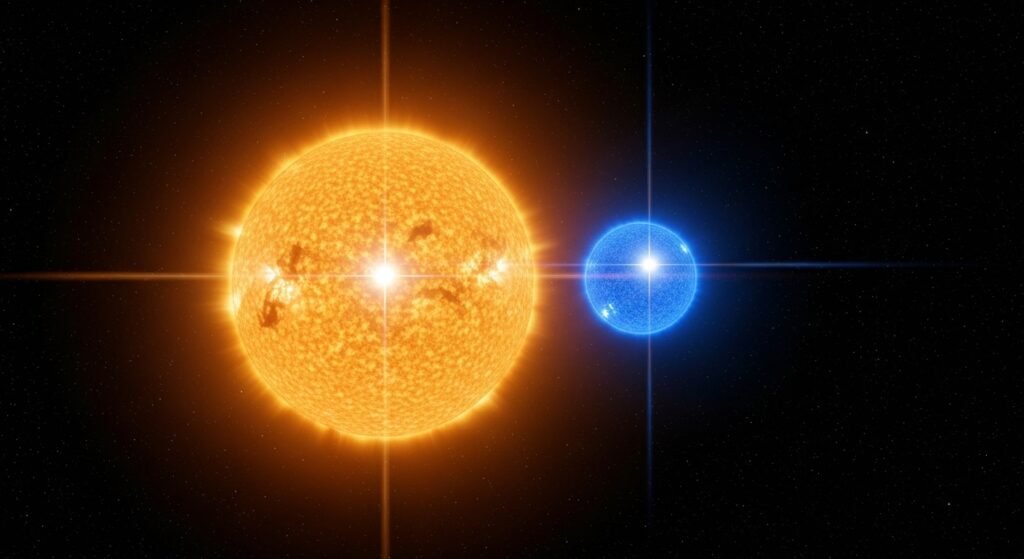
If Deneb is the most famous star in Cygnus, Albireo is easily the most beautiful.
Through a telescope, Albireo appears as a stunning pair of stars—one glowing golden-orange and the other shining bright blue. This color contrast makes it one of the most popular double stars for amateur astronomers.
Albireo marks the head of the swan in the Cygnus constellation. While it looks like a single star to the naked eye, even a small telescope reveals its twin nature.
This visual pairing creates a striking cosmic color combination that has fascinated observers for centuries.
Many beginners describe their first view of Albireo through a telescope as unforgettable. It’s often one of the first objects astronomy enthusiasts show to friends or family during stargazing sessions.
Sadr – The Heart of Cygnus
Another important star in Cygnus is Sadr, located at the center of the Northern Cross. Its name comes from an Arabic word meaning “the chest.”
This makes perfect sense because Sadr marks the heart or chest of the swan.
Although slightly dimmer than Deneb, Sadr sits in a particularly rich region of the Milky Way. Around it lies a huge cloud of glowing gas and dust known as the Gamma Cygni Nebula.
When astronomers photograph this region, they capture breathtaking images filled with swirling red nebulae and countless stars. It’s one of the most photogenic areas of the entire night sky.
For amateur astronomers using binoculars or telescopes, this region offers a stunning view of the dense star fields of our galaxy.
Deep Sky Objects Inside Cygnus
The North America Nebula
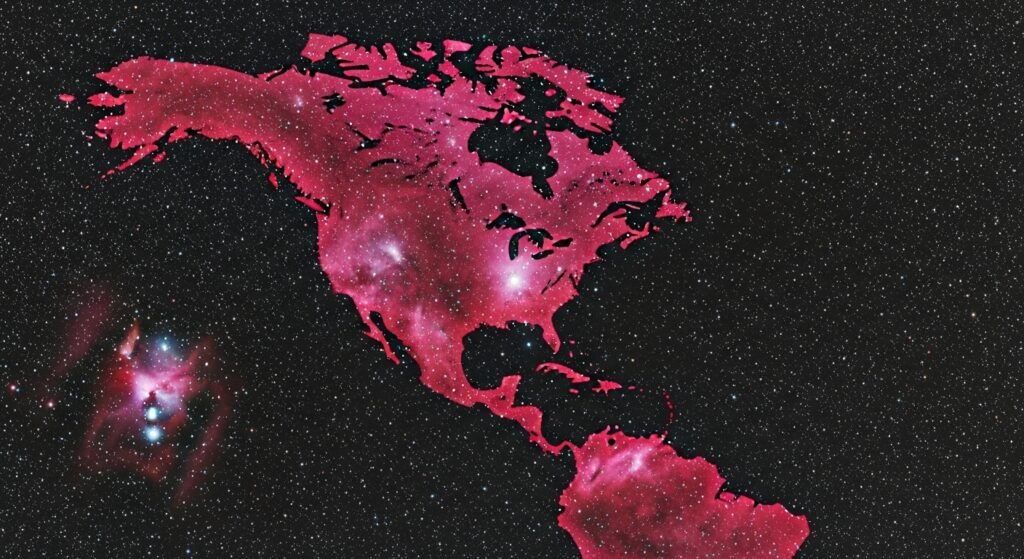
Cygnus is home to some of the most fascinating objects in the Milky Way. One of the most famous is the North America Nebula, a massive cloud of glowing gas that resembles the shape of the North American continent.
This nebula lies near Deneb and spans a huge region of space. Under dark skies and with the right equipment, astronomers can see its faint glow against the backdrop of the Milky Way.
Nebulae like this are stellar nurseries where new stars are born. Over millions of years, gravity pulls gas and dust together until nuclear fusion ignites, creating brand new stars.
Seeing a nebula like this reminds us that the universe is constantly evolving.
The Cygnus Loop Supernova Remnant
Another spectacular object in this constellation is the Cygnus Loop, a massive expanding cloud of gas created by a stellar explosion that occurred about 10,000 years ago.
When a massive star runs out of fuel, it can explode in a supernova. The Cygnus Loop is the glowing shell left behind by one such cosmic catastrophe.
Today, astronomers study this structure to understand how supernova explosions shape galaxies and trigger the formation of new stars.
Even though the explosion happened thousands of years ago, its expanding shockwave is still traveling through space today.
How to Find Cygnus in the Night Sky
Step-by-Step Star-Hopping Method
Finding Cygnus is easier than many people expect.
Start by locating the Summer Triangle. Look for three bright stars forming a large triangle overhead during summer evenings.
Then follow these steps:
- Locate Vega first—it’s extremely bright.
- Find Altair forming another corner of the triangle.
- The third corner is Deneb.
- Once you see Deneb, trace the cross shape downward to reveal Cygnus.
Within minutes, the entire constellation becomes visible.
Using Stargazing Apps and Binoculars
Modern technology makes stargazing easier than ever.
Smartphone apps like Star Walk 2 or SkyView can instantly identify Cygnus by pointing your phone at the sky.
Binoculars are also extremely useful. They reveal star clusters such as M29 and M39, which are invisible to the naked eye but easy to observe with simple equipment.
Why Cygnus Is Perfect for Beginner Stargazers
Easy Patterns and Bright Stars
Cygnus offers the perfect entry point for beginners. Its large size and bright stars make it easy to recognize even from suburban locations.
Unlike some constellations that require charts or experience to find, Cygnus practically introduces itself. Once you see the Northern Cross pattern, it becomes unforgettable.
Rich Milky Way Star Fields
Perhaps the most magical thing about Cygnus is its location within the Milky Way.
When you observe this region from dark skies, you’ll notice countless faint stars scattered across the sky like cosmic dust. This is because you’re looking directly into one of the densest parts of our galaxy.
For beginners, this creates an unforgettable stargazing experience that often sparks a lifelong fascination with astronomy.
Conclusion
The Cygnus constellation is one of the most spectacular sights in the night sky. With its recognizable swan shape, bright stars like Deneb, and location within the Milky Way, it offers a perfect starting point for anyone interested in astronomy.
From ancient mythology to modern astrophysics, Cygnus connects human imagination with the vast universe beyond our planet. It contains stunning stars, beautiful nebulae, and the remnants of powerful supernova explosions.
For beginners, few constellations are as rewarding to explore. Once you learn to spot the Northern Cross and follow the trail of the Milky Way, Cygnus quickly becomes one of the most familiar patterns in the sky.
The next time you step outside on a clear night, look up. The swan might already be flying overhead.
FAQs
1. What does Cygnus mean?
Cygnus comes from the Latin word for “swan.” The constellation’s star pattern resembles a swan flying through the Milky Way.
2. When is the best time to see Cygnus?
The constellation is easiest to observe from July through November, with September often providing the best viewing conditions.
3. What is the brightest star in Cygnus?
The brightest star is Deneb, a blue-white supergiant and one corner of the Summer Triangle.
4. Is Cygnus visible without a telescope?
Yes. Several of its stars are easily visible to the naked eye, making it one of the best constellations for beginners.
5. Does Cygnus contain any famous space objects?
Yes. The constellation includes objects like the North America Nebula, Cygnus X-1 black hole, and the Cygnus Loop supernova remnant.