What If Earth Had Two Moons? A Hypothetical Scenario
Understanding Earth’s Current Moon System
How the Moon Shapes Life on Earth
The Moon is far more than a beautiful object in the night sky—it is a fundamental component of Earth’s environment and stability. Orbiting roughly 384,400 kilometers from Earth, our Moon influences everything from ocean tides to the rhythm of life on our planet. Its gravitational pull creates the daily rise and fall of the oceans, helping shape coastlines, ecosystems, and even the migration patterns of marine animals. Without the Moon, Earth would look very different both physically and biologically.
Think of the Moon as Earth’s quiet partner in a cosmic dance. The two bodies orbit a shared center of gravity called the barycenter, which lies beneath Earth’s surface. This gravitational relationship causes ocean water to bulge toward and away from the Moon, creating the familiar pattern of high and low tides. Coastal ecosystems—from coral reefs to tidal wetlands—depend heavily on these predictable cycles to survive and thrive.
The Moon also influences the evolution of life itself. Many marine organisms synchronize reproduction with lunar phases, while nocturnal animals use moonlight for hunting and navigation. Humans have long relied on the Moon for calendars, agriculture, and navigation across oceans. In short, Earth’s Moon is not just a decoration—it is a major environmental regulator.
Imagining Earth with two moons instead of one, therefore, raises fascinating questions. How would tides change? Would nights be brighter? Could the gravitational balance that stabilizes Earth remain intact? Scientists exploring this hypothetical scenario believe the answer is complex. The outcome would depend on factors such as the size, distance, and orbit of the second moon. What’s clear, however, is that adding another lunar companion would transform Earth’s environment in dramatic ways.
The Moon’s Role in Tides and Planetary Stability
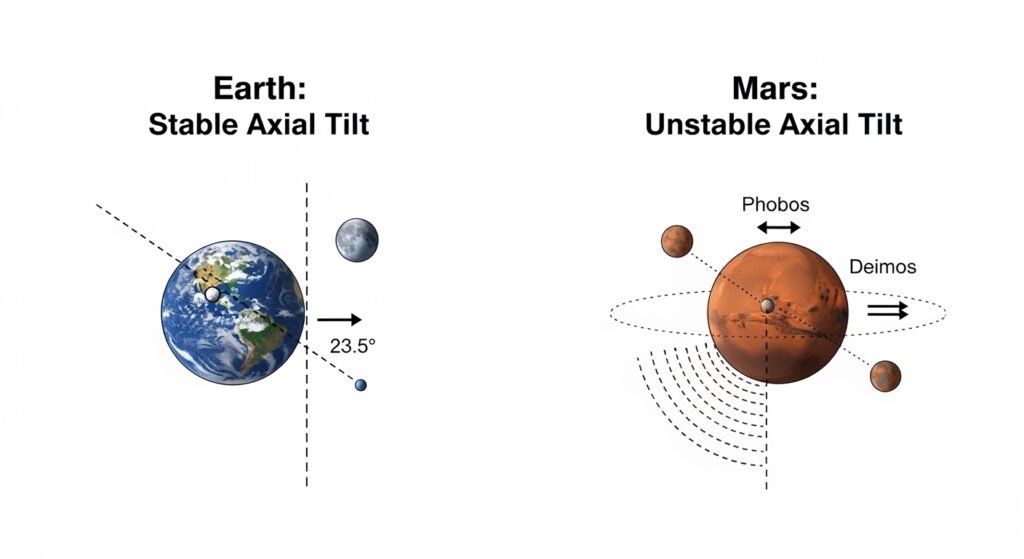
The Moon’s gravitational influence extends beyond the oceans—it also stabilizes Earth’s axial tilt, the angle between Earth’s rotational axis and its orbit around the Sun. This tilt, currently about 23.5 degrees, is responsible for Earth’s seasons. Without the Moon’s stabilizing pull, Earth’s tilt might wobble dramatically over millions of years, potentially causing extreme climate swings.
Astronomers often compare Earth with Mars to understand this effect. Mars has small moons that exert little stabilizing influence, and its axial tilt changes significantly over geological time. Earth’s large Moon acts like a stabilizing weight, helping maintain relatively stable seasons that allow ecosystems—and civilizations—to flourish.
The Moon also gradually slows Earth’s rotation through tidal friction. Over billions of years, this interaction has lengthened the day from about 6 hours in Earth’s early history to the current 24 hours. This gradual slowing influences atmospheric patterns and climate systems.
Now imagine introducing a second moon into this delicate gravitational balance. Suddenly, Earth would be subject to competing gravitational pulls. Depending on the masses and orbital paths of the two moons, they could either enhance Earth’s stability or destabilize it. Some models suggest that multiple moons could create chaotic gravitational interactions that eventually lead to collisions or ejections from orbit.
This possibility is not purely theoretical. Some simulations of early solar system formation suggest that Earth may have once hosted multiple small moons formed from debris after a massive planetary collision. Over time, gravitational interactions may have caused these moonlets to merge or disappear, leaving behind the single Moon we see today.
Understanding these dynamics helps scientists explore what Earth might look like under different cosmic conditions. It also reveals how unusual—and fortunate—our current Earth-Moon system truly is.
Could Earth Actually Have Two Moons?
The Giant Impact Hypothesis
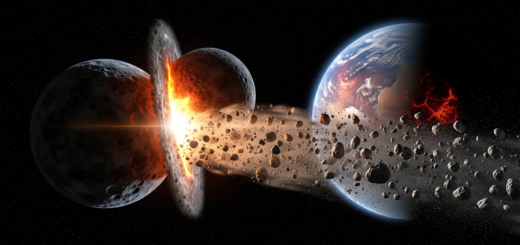
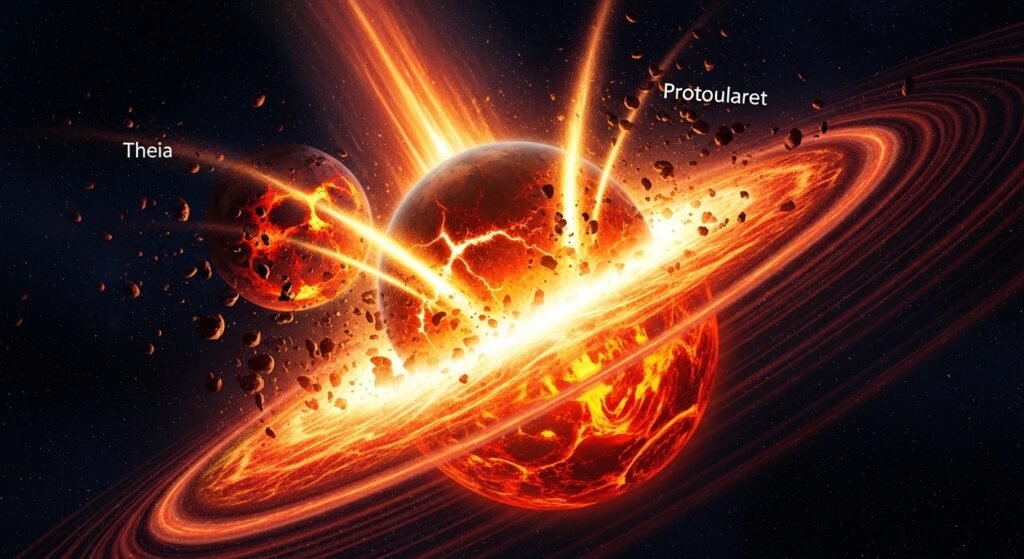
The leading explanation for the Moon’s origin is known as the Giant Impact Hypothesis. According to this theory, about 4.5 billion years ago, a Mars-sized body called Theia collided with the early Earth. The impact ejected enormous amounts of molten rock and debris into orbit around the planet. Over time, this debris gradually coalesced to form the Moon.
This event was not a simple collision but a chaotic process involving vast disks of debris circling the planet. Computer simulations suggest that this debris could have formed multiple smaller satellites, sometimes called moonlets, rather than a single large Moon. These moonlets may have orbited Earth simultaneously for millions of years before merging or colliding.
In some models, two moons existed at the same time for roughly 80 million years, orbiting Earth in separate paths. Over time, gravitational interactions destabilized their orbits, causing the smaller moon to collide with the larger one in a slow-motion impact.
This collision may explain one of the Moon’s biggest mysteries: the difference between its near side and far side. The side facing Earth is smoother and flatter, while the far side is more mountainous and has a thicker crust. Scientists believe debris from the smaller moon may have piled onto one hemisphere during the collision, creating this uneven structure.
These models show that a two-moon Earth is not purely science fiction. Our planet may actually have experienced such a system early in its history.
Evidence That Early Earth May Have Had Two Moons
Astronomical simulations continue to support the possibility that Earth once hosted multiple moons during its early formation. When large impacts occurred during planetary formation, each impact could create a debris disk capable of forming its own moonlet. Over time, these smaller satellites might migrate outward due to tidal forces and eventually merge with one another.
This process could naturally produce a system where two or more moons orbit Earth simultaneously before gravitational interactions eventually simplify the system. When two moons interact gravitationally, several outcomes are possible:
- The moons collide and merge.
- One moon is ejected from Earth’s orbit.
- One moon crashes into Earth.
- The moons settle into a stable configuration.
The Earth-Moon system we see today likely represents the final outcome of such complex interactions.
These theories provide an important reminder: planetary systems are not static. They evolve over millions or billions of years through collisions, gravitational shifts, and orbital changes. What seems stable today may have once been far more chaotic.
The Immediate Visual Impact of Two Moons
A Brighter Night Sky
If Earth suddenly had a second moon comparable in size to the current Moon, the first noticeable change would be a dramatically brighter night sky. The Moon already reflects sunlight with remarkable efficiency, lighting landscapes during full moon phases. Two moons would double this illumination, potentially making many nights feel closer to twilight.
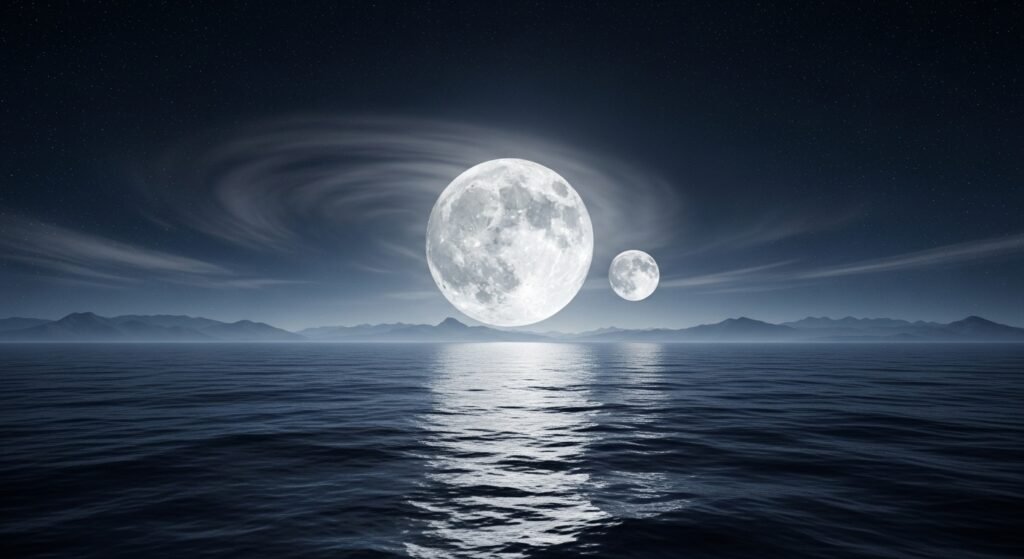
Imagine standing on a quiet beach at night and seeing two glowing moons rising over the ocean. Depending on their orbital positions, they might appear side by side, or one might trail behind the other across the sky. The changing phases of two moons would create an ever-shifting display of crescents, halves, and full moons.
Astronomers speculate that such a sky would be visually spectacular but also scientifically fascinating. Different lunar phases could overlap in complex ways. One moon might be full while the other is a thin crescent. Occasionally, both could appear full at the same time, producing extraordinarily bright nights.
For early human societies, this celestial display would likely have shaped mythology, religion, and storytelling even more profoundly than our single Moon already has. Cultures might develop legends about twin lunar gods or competing celestial spirits, reflecting the dual presence in the sky.
Double Lunar Phases and Celestial Events
Two moons would also create new types of astronomical events. Today, we experience lunar eclipses when Earth’s shadow falls on the Moon and solar eclipses when the Moon blocks the Sun. With two moons, the possibilities multiply.
Potential celestial events could include:
- One moon eclipsing the other.
- Double lunar eclipses.
- Overlapping solar eclipses.
- Two moons appear full simultaneously.
Such events would provide spectacular opportunities for astronomy and observation. The complexity of predicting these events would also drive the development of advanced astronomical calendars much earlier in human history.
Ocean Tides in a Two-Moon World
Stronger Gravitational Forces
The Moon’s gravity is responsible for Earth’s tides, and introducing a second moon would amplify this effect dramatically. Each moon would create its own tidal bulge in Earth’s oceans. When both moons align with Earth, their gravitational forces could combine to produce extremely high tides.
Some estimates suggest that tidal forces could become several times stronger than current tides, dramatically reshaping coastlines and coastal ecosystems.
These stronger tides could erode coastlines much faster than today. Rivers might experience powerful tidal waves traveling upstream, while low-lying coastal regions could face frequent flooding.
Unpredictable Tidal Patterns
Beyond stronger tides, the presence of two moons would create complex and irregular tidal patterns. Instead of two predictable high tides per day, some regions might experience three or four tidal cycles depending on the positions of the moons.
This unpredictability would make coastal living more challenging. Ports, cities, and coastal infrastructure would need to adapt to constantly shifting water levels. Marine ecosystems would also evolve to survive these fluctuating conditions.
Effects on Earth’s Climate and Rotation
Axial Tilt Stability
The gravitational interaction of two moons could influence Earth’s axial tilt in unpredictable ways. In some cases, the moons might stabilize Earth’s tilt even more strongly than a single moon. In others, their competing gravitational pulls could destabilize the system, causing long-term changes in Earth’s climate patterns.
Changes in axial tilt could alter the intensity of seasons and potentially lead to long cycles of climate change.
Longer Days and Planetary Spin Changes
Two moons would increase tidal friction on Earth’s rotation. This means Earth’s rotation could slow more quickly, gradually lengthening the length of a day over millions of years.
The increased tidal forces might also influence the planet’s internal structure, slightly altering the distribution of mass within Earth’s mantle and crust.
Geological Consequences of Two Moons
Increased Earthquakes and Volcanic Activity
Stronger tidal forces would not only affect oceans—they would also influence the solid Earth. The gravitational tug of two moons could flex Earth’s crust more strongly, potentially increasing geological activity.
Scientists speculate that this could lead to more frequent earthquakes and volcanic eruptions, particularly in tectonically active regions.
Coastal Erosion and Changing Landscapes
Higher tides would accelerate coastal erosion. Beaches, wetlands, and river deltas could change shape rapidly over time. Coastal cities might need to be built farther inland to avoid constant flooding.
These changes would reshape Earth’s geography and influence where human civilizations develop.
Biological and Ecological Impacts
How Wildlife Would Adapt
Many species rely on lunar cycles for survival. With two moons, these biological rhythms might become more complex. Animals that depend on moonlight for hunting or navigation might evolve new behaviors to adapt to brighter nights.
Marine species that spawn during certain tidal conditions could also evolve different reproductive strategies.
Evolution Under Brighter Nights
Brighter nights might benefit predators that hunt using sight, while prey species might develop stronger camouflage or nocturnal defenses.
Over millions of years, ecosystems could evolve entirely new patterns of behavior shaped by the presence of two lunar cycles.
Human Civilization in a Two-Moon World
Cultural and Calendar Changes
Human societies have always used the Moon to track time. With two moons, calendars could become more complex, possibly incorporating multiple lunar cycles.
Festivals, religious traditions, and mythology would likely revolve around the interactions between the two moons.
Navigation, Mythology, and Astronomy
Seafarers historically relied on lunar cycles to predict tides. With two moons, navigation would require more advanced astronomical knowledge. This complexity might accelerate the development of early astronomy and mathematics.
The presence of two moons would also inspire countless myths, stories, and artistic traditions centered on the twin lights of the night sky.
Conclusion
Imagining Earth with two moons reveals just how influential our current Moon really is. A second moon would transform the night sky, create stronger and more complex tides, and potentially reshape Earth’s climate and ecosystems. Geological activity could increase, coastlines might erode faster, and human societies would likely develop entirely different cultural traditions around the dual lunar presence.
Scientific models suggest that Earth may actually have hosted multiple moons during its early history before gravitational interactions merged them into the single Moon we see today. This possibility highlights the dynamic nature of planetary systems and reminds us that cosmic history is filled with dramatic events.
Our solitary Moon may appear simple, but its presence is the result of billions of years of cosmic evolution. The delicate balance between Earth and its lunar companion has helped create the stable environment that allowed life—and eventually human civilization—to flourish.
FAQs
1. Could Earth realistically have two moons today?
It is theoretically possible, but maintaining a stable orbit for two large moons would be extremely difficult. Gravitational interactions would likely destabilize the system over long periods.
2. Did Earth ever have two moons in the past?
Some scientific models suggest that Earth briefly had two moons early in its history before they merged through a slow collision.
3. Would two moons make nights much brighter?
Yes. If both moons were similar in size to the current Moon, nights would often be significantly brighter due to increased reflected sunlight.
4. How would tides change with two moons?
Tides could become much stronger and more unpredictable, potentially producing multiple high tides per day.
5. Would life on Earth survive with two moons?
Life could still exist, but ecosystems, climates, and biological rhythms would likely evolve differently due to stronger tides and brighter nights.
Did you find our exploration of a ‘Two-Moon Earth’ fascinating? In fact, our planet might have actually hosted more moons in the distant past. Check out our [https://cy24cloud.com/nasa-two-moons-earth-understanding-the-mystery-of-earths-second-moon/] to discover more incredible scientific hypotheses hidden behind the origins of the Moon.